


The Silent Sermon: Why Our (Theravada) Buddhist Centres Need More Than Just a Statue
As I walked through countless Malaysian Buddhist halls across Malaysia. And time and again, I find myself quietly asking: What does this space teach, before a single word is spoken?
Too often, the answer is: very little.
Walk into many Malaysian Buddhist centres today - particularly those of Theravada orientation - and you will find a familiar scene. A Buddha statue. A shrine. Oil lamps, flowers, candles. Perhaps a few smaller statues. Maybe a Dharma wheel tucked in a corner, or some lotus carvings if you’re lucky. But beyond that? Bare walls. Empty space. A silence that is not the silence of meditation, but the silence of missed opportunity.
Contrast this with the Thai and Sinhalese Theravada, or Chinese Mahayana and Tibetan Buddhist temples in our country, where indigenous art, carvings, and murals burst with the life and teachings of the Buddha. There, even a child can learn a story just by looking up.
So we must ask: Why and when did this “minimalist” aesthetic take root among us? Some say it is inspired by Japanese temples. But Japanese Zen centres often integrate gardens, stone arrangements, and calligraphy - each a teaching in itself. Here, we rarely even have a garden.
Perhaps cost is the excuse. Land in Kuala Lumpur is precious, and building is expensive. But if Thai and Sinhalese Theravada temples can raise funds for intricate carvings and paintings, why cannot Malaysian run Theravada centres find room for symbols that educate?
What I Learned Walking Through Suan Mokhh Bangkok
In April 2023, I visited the Buddhadasa Indapanno Archives Foundation (BIA) in Bangkok - better known as Suan Mokhh Bangkok. The building itself is industrial, minimalist, unassuming. But the grounds outside took my breath away.
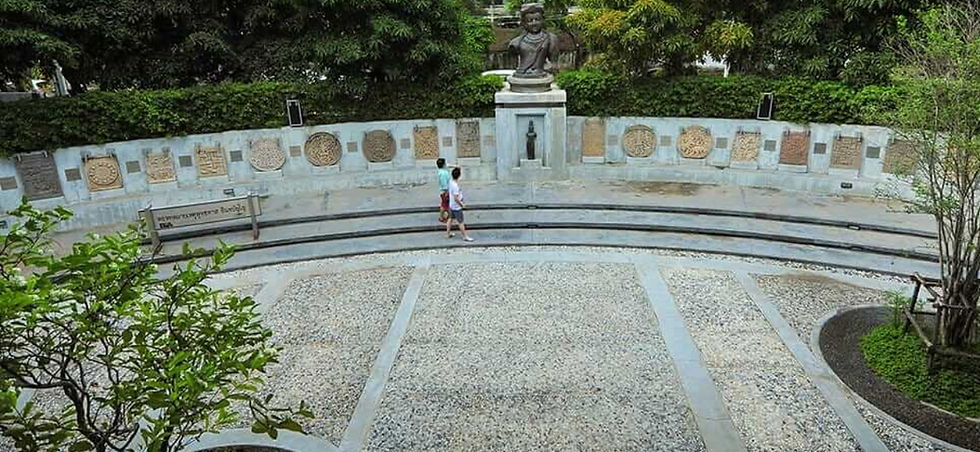
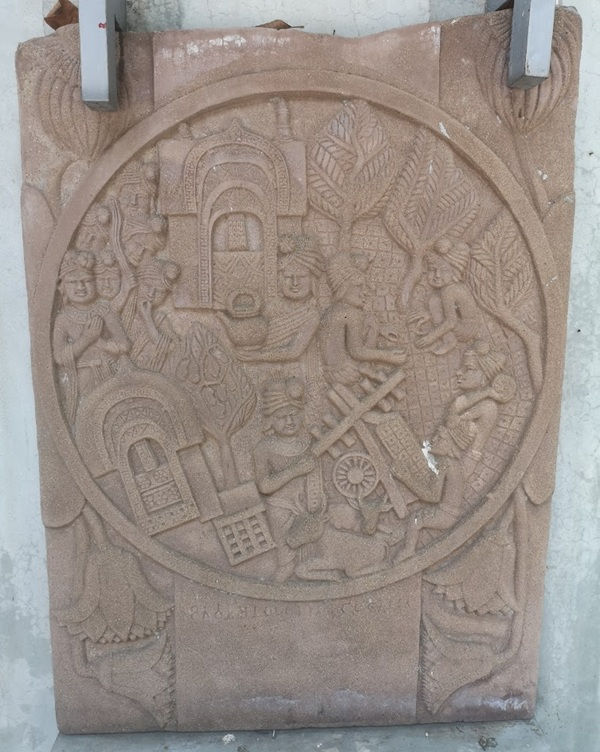
There, scattered like open books, were dozens of Buddhist symbols: replicas of ancient murals from Ajanta, Sanchi, and Amaravati. Not mere pictures, but carved reminders of aniconic Buddhism - the Bodhi Tree, the Dharma wheel, the empty throne, the Buddha’s footprints, the Triple Gem, and even dependent origination folktales. Tibetan thangkas illustrating meditation processes.

A simple cement monument with five poles - representing the five key events of the Buddha’s life, or the five hindrances, or the five aggregates. Each display came with a plaque in Thai and English, plus a QR code for deeper learning.

I walked through that space unaccompanied. No teacher. No talk. Yet by the time I reached the Dharma hall, I had already absorbed more Buddhist knowledge than in some centres I’ve visited for years.
That, dear readers, is the power of a building that teaches.
A Challenge to Malaysian Theravada Buddhist Centres
We have the real estate. We have the walls. We have the visitors who come, light incense, and leave - often without having learned a single new thing. Why not turn every corridor into a learning path? Why not make every pillar a storyteller? Why not make every empty wall a teaching canvas.
What we need is not expensive renovation, but thoughtful curation. A storyboard. A theme. A choice of medium - sculpture, painting, modern installation, graphic art, even hologram or 3D animation. The aim is not decoration, but education: historical context, cultural richness, and Dharma meaning woven together.
Invite artistic inclined members to produce the art works. Allow for creativity to enable local culture to be projected. Maybe batik art to showcase life of the Buddha, or blending of Southeast Asian motifs with modernist techniques to illustrate lessons from the Jataka.
And here is the deeper opportunity. Once symbols fill our spaces, our regular devotees can become storytellers. Every auntie who lights oil lamps, every uncle who sweeps the hall, can guide a newcomer through the Buddha’s life. Imagine a centre where every member becomes an ambassador of the Dharma. That is democratisation of Dhamma outreach - not through lectures, but through shared wonder.
We have all heard how hard it has been to draw devotees back after Covid. Perhaps the pandemic did not only close our doors - it revealed how little our spaces themselves were offering. If Chinese Mahayana temples can do it, if Suan Mokhh Bangkok can do it, then I see no reason why any Malaysian Buddhist centre cannot.
The Buddha taught with flowers, silence, and walking paths. Let our buildings do the same.
Let them preach without a single sermon. Let them be, in themselves, a refuge of learning.
Because a statue alone is not a teacher. But a centre alive with symbols? That is a Dharma wheel already turning.


Comments